
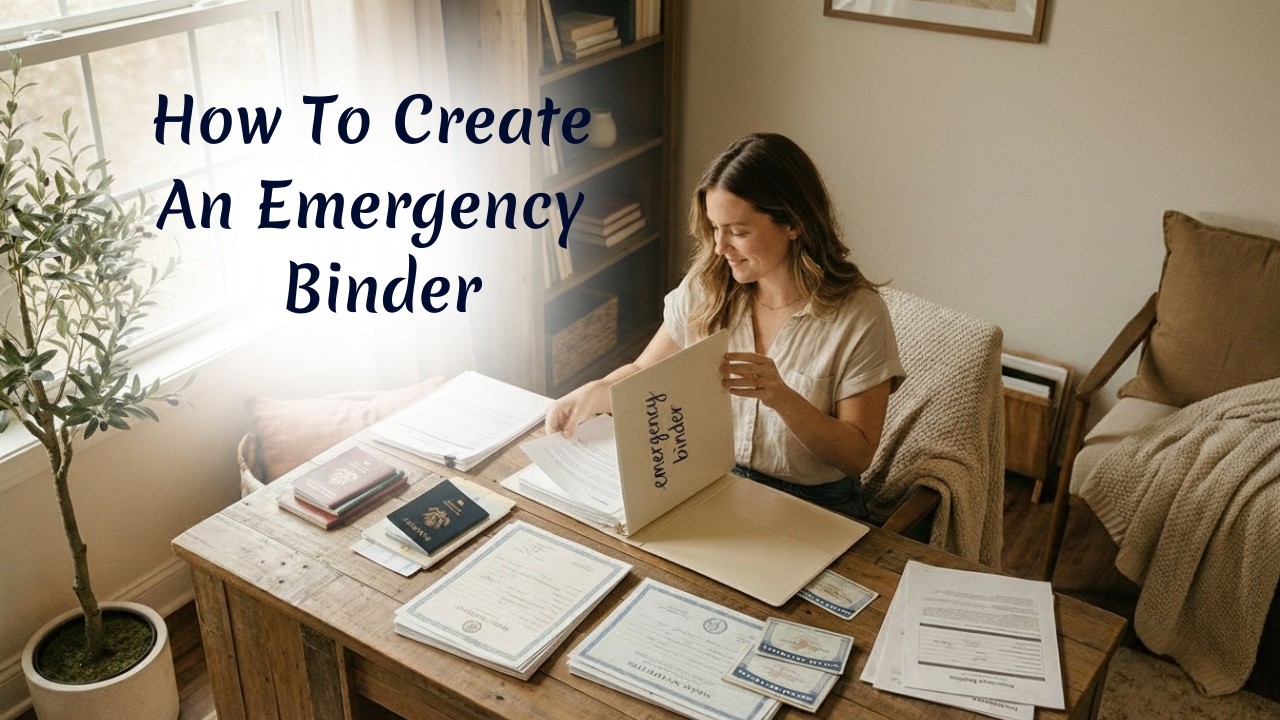
Some of the best practical life advice for women has nothing to do with doing more. It has to do with making life easier when things get hard. And an emergency binder is one of those simple, grown-woman systems that can save time, reduce panic, and help you think clearly when clear thinking is in short supply.
For many women, important information lives in a hundred places at once: a kitchen drawer, a file box, a phone, an email account, a purse, a random pile on the counter, and unfortunately, inside your own head. That may work on an ordinary Tuesday. It does not work nearly as well during a medical emergency, evacuation, or family crisis.
This is why an emergency binder matters. It is not about fear. It is about peace of mind. It is about being able to grab what you need, find what you need, and help the people you love without turning the house upside down first.
If you have been wanting more practical life advice for women that actually fits real life, this is a strong place to start.
Let’s begin here, because this matters: an emergency binder does not need to be fancy to be useful.
The purpose is simple. Gather the most important information and documents you would need in a day-to-day emergency or a true catastrophe, and keep them in one portable place. That is it.
You do not need to create a masterpiece. You do not need to organize every paper you own. You do not need to finish it all in one sitting.
In fact, one of the most helpful pieces of practical life advice for women is to stop thinking of this as one giant project. Start with one piece. One card. One section. One envelope. Even getting your most vital papers into one safe, portable location puts you far ahead of where you were yesterday.
And here is the part many women appreciate once they do it: this binder is not only for disasters. It helps with regular life too. Need a birth certificate? A Social Security card? A VIN number? Insurance details? If it is all in one place, you stop wasting time hunting and re-hunting for the same information.
If you are not sure where to begin, start small with the refrigerator cards, sometimes called fridge cards. First responders are often trained to look at the fridge for emergency information, which makes this an especially practical first step.
The idea is straightforward: place critical information in a clearly marked envelope on the refrigerator. One card can be created for each adult, child, and even each pet.
These cards are meant to speak for you if you cannot speak for yourself. That is why they are so valuable.
You can use the free first responder cards from Life A-Go-Go if you want a ready-made starting point. They are a helpful way to begin without overthinking the format.
What belongs on an adult identity card?
That last one may not seem obvious, but it matters. Some older adults revert to their first language under stress or with age. If someone is not responding in English, that information could make a real difference.
This kind of practical life advice for women may sound basic at first glance, but basic is exactly what helps during a crisis. When stress hits, the brain does not suddenly become more organized. It usually does the opposite.
An emergency binder should reflect the life you actually live.
That means if minors are often in your home, even if they are not your children, it may make sense to include cards for them. Grandchildren, nieces, nephews, or children you regularly care for all fall into that category.
The same goes for pets. In a crisis, pets can be overlooked, separated, or become one more source of stress in an already stressful situation. A pet identity card can include:
This is one of those forms of practical life advice for women that carries a lot of emotional weight. Most of us are not just organizing paper. We are trying to protect people and animals we love.
And when you think of it that way, taking time to prepare does not feel dramatic. It feels responsible.
In addition to identity cards, it helps to make a first responder card that is more medically focused.
This card can include important details such as:
That last item is especially important. Medications are not always stored in one tidy medicine cabinet. Some are kept near a bed, in a bag, or in another room. In a critical moment, being able to point someone directly to life-saving medication is no small thing.
Then there is the wallet card. This is a smaller version meant to be carried in a wallet or kept on a car visor. It can alert others that there are pets or minors at home who may need attention if something happens to you away from the house.
Again, this is practical life advice for women in the truest sense: it prepares for real-world scenarios without making life harder.
There is something humbling about stress. Information you know perfectly well on an ordinary day can vanish when adrenaline shows up.
That is why a written emergency contact list matters, even if the phone numbers seem obvious.
Your list can include:
If you ever need to call for help, being able to read this information rather than pull it from memory can make things much easier. That is especially true if you are emotional, injured, frightened, or trying to help someone else at the same time.
Sometimes the most practical life advice for women is simply this: write it down before you need it.
Now for the heart of the binder: your vital documents.
One smart rule here is not to treat the binder like a storage unit for every important paper you have ever owned. Keep it focused on documents you would actually need in an emergency and documents that are difficult to replace.
Think in categories.
Personal documents:
That utility bill may not seem glamorous, but it can be incredibly important after a disaster. If access to a neighborhood is restricted, proof of residency may be required before you are allowed back in.
Medical documents:
Photos:
Physical photos matter. They can help identify children, elderly relatives, and pets if people get separated. Family photos together can also help establish relationships quickly in confusing situations.
Financial and legal documents:
If you want a more complete ready-made system, Life A-Go-Go also offers a full emergency binder, and their home inventory resource can help with documenting belongings for insurance and recovery purposes.
This final section may be the most practical of all.
First, do not rely only on digital storage. Phones die. Cell service fails. Power goes out. Two-factor authentication can become a real problem if your device is missing or not working. Cloud storage is useful as a backup, but it is not enough on its own.
Paper still has a job to do.
Second, keep the binder where it can be found. Many people hesitate here because they worry someone might snoop through their paperwork. But in most household theft situations, thieves are not usually hunting for your binder full of copies. They are after quick valuables.
So put the binder somewhere accessible, tell the right people where it is, and do not let fear keep you from making the system usable. If you want to label it something plain, that is fine too.
Third, avoid making the safety deposit box your primary plan. In a crisis, banks may be closed, access may be delayed, and only certain people may be allowed to retrieve what is inside. That creates too many barriers.
Finally, update your binder at least twice a year. You can tie updates to life events that are easy to remember:
Once the binder exists, updates are usually much faster than starting from scratch. A quick review can often be done in 20 to 30 minutes.
That is what makes this such good practical life advice for women. It is not a one-time grand gesture. It is a manageable system that supports real life over time.
If this topic speaks to where you are right now, you can find more organizing and preparedness resources at Life A-Go-Go.
At the end of the day, an emergency binder is not really about paper. It is about reducing chaos. It is about helping your future self. It is about making sure the people who need information can get it, even on the worst day.
And truly, that may be some of the most practical life advice for women there is: prepare in peace, so you are not forced to create order in the middle of panic.