
Organizing advice sounds simple until you try to live with it. You buy the bins. You label the drawers. You promise yourself that this time you’ll keep up. A few weeks later the papers are back on the counter, the closet is a fight again, and you’re wondering if you’re just not organized enough. This is where Clutterbug and Four Tendencies come in.
We don’t think that’s the real problem. Mary’s take is refreshingly practical: a lot of systems fail because they weren’t built around the way your brain naturally processes information. And even a well-designed system can fall apart if it doesn’t match how you handle expectations and follow-through. That’s exactly where pairing Clutterbug and Four Tendencies gets so helpful. Together they show you both how you like to organize and what keeps you actually doing it.
The short answer
The Clutterbug and Four Tendencies approach works because it puts two pieces of the puzzle together: your organizing style and your motivation style. Once you know both, you can build systems that feel natural to use and realistic to keep up. Instead of forcing yourself into someone else’s method, you shape something around how you think, what you need to see, and what actually helps you follow through day to day.
Why so much organizing advice fails
Most organizing advice assumes one system should work for everyone. Tidy in theory. But real homes and real people don’t run that way. Some of us need to see our belongings or we forget they exist. Others feel calmer with everything tucked away. Some love detailed categories and labels. Others need broad, easy groupings they can keep up without extra thought.
So when a system feels exhausting, it might not be because you’re lazy or flaky. It might just be the wrong fit. Mary points to two organizing preferences from Cas Aarssen’s Clutterbug framework: whether you prefer visual abundance or visual simplicity, and whether you like to micro-sort or macro-sort. Those two preferences create four Clutterbug types. Once you know your dominant one, organizing gets a lot less personal and a lot more practical. You stop trying to force a system that looks good on paper but never feels natural in your house.
Trying harder isn’t the answer, fit is
Mary frames this in a way a lot of us will recognize: we assume the answer is trying harder. If the bins didn’t help, maybe we need more bins. If the labels didn’t stick, maybe we need prettier labels. And to be fair, there’s nothing wrong with a good bin. Mary loves them too.
But products aren’t the point. Fit is the point. The goal is spaces that work with your natural wiring, so you’re not constantly rethinking, redoing, and rescuing your own systems. When your setup matches the way your brain already works, staying organized asks for a lot less daily effort. That’s a much kinder place to start.
The four Clutterbug types
The Clutterbug framework starts with two questions. Do you like to see your things, or do you prefer them hidden away? And do you like detailed categories, or broader groupings? Here’s how the preferences shake out:
- Visual abundance: if it’s out of sight, it’s genuinely out of mind.
- Visual simplicity: calm comes from clean surfaces, closed doors, drawers, baskets, and hidden storage.
- Micro-sorting: you like specific categories, subcategories, and detail.
- Macro-sorting: you prefer broad homes for things, without a lot of subdivisions.
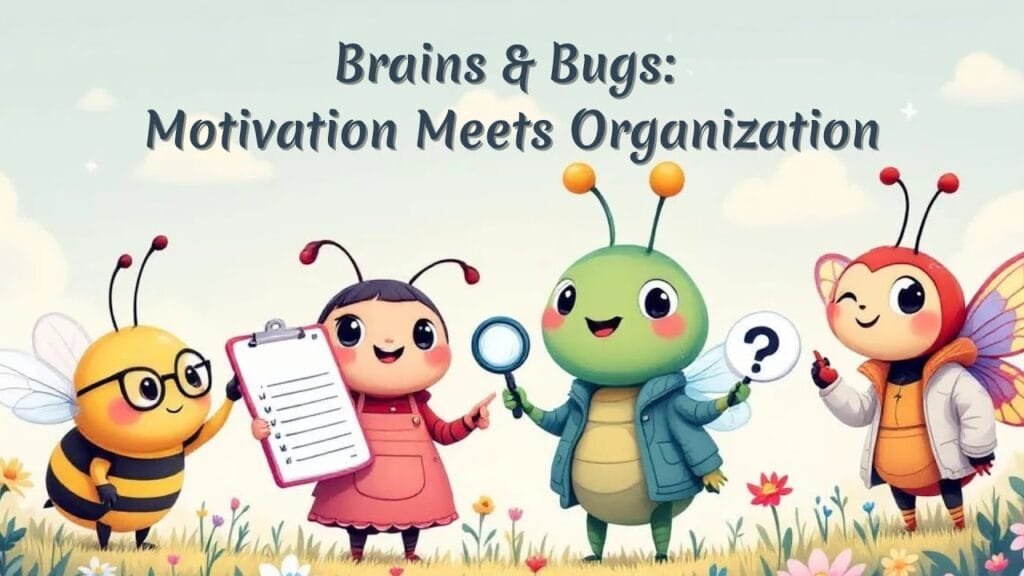
Combine those and you get four styles: Bee, Butterfly, Cricket, and Ladybug. If you’re curious about yours, take the free Clutterbug quiz.
Bees: visible and detailed
Bees like visual abundance and detailed storage. Mary calls herself a Bee, and her examples make it easy to picture. A Bee wants to see a lot of what she owns, but sorted clearly and specifically. Visible systems, with structure. Clear containers, pegboards and bulletin boards, labeled systems, clear stacking drawers, project boxes, and pocket file folders for unfinished work all tend to work well.
This is the woman whose pens are out on the desk, but grouped by type and color. Office supplies are visible, and the staples, paper clips, and binder clips each have their own spot. Bees do best when they can spot what they need at a glance. Visibility matters, but so does order. If you’re a Bee, one common trap is trying to become a minimalist with closed storage everywhere. It looks calmer at first, but if you can’t see what you have, you’ll quietly stop using the system and start building “temporary” piles out in the open.
Butterflies: visible and simple
Butterflies also want visual abundance, but not the detailed sorting. They’re macro-sorters. In real life that means they need easy, visible storage that lets them put things away fast without a lot of decisions. Open shelving, large clear bins, cubbies, and wall hooks are a good fit.
Butterflies struggle with anything that takes too many steps. If putting clothes away means opening a drawer, folding just so, and hanging every item perfectly, odds are the bedroom chair becomes the backup system. Hooks and open bins work better because they cut the friction. It’s a good reminder that “organized” doesn’t have to mean hidden and intricate. For a Butterfly, simple and visible might be the most functional setup in the house.
Crickets: hidden and detailed
Crickets prefer visual simplicity and micro-organization. They want things out of sight, and carefully sorted. This style thrives with contained, detailed systems: drawer dividers, subdivided totes, caddies, opaque containers, and closet or cabinet storage. A Cricket feels best when things are tucked away neatly and can be pulled from very specific categories when needed.
Mary flags one important caution here: paperwork can get tricky for Crickets. Because they like detailed categories, they can build a filing system so specific it becomes hard to maintain. That’s a good spot to be honest with yourself. A beautiful, detailed system isn’t always a sustainable one. If your paper setup feels too complicated to keep up, that’s your sign to simplify before the piles come back.
Ladybugs: hidden and simple
Ladybugs want visual simplicity too, but they’re macro-sorters. They like things hidden away, with storage that’s easy and broad. Large bins, open drawers, simple drawer dividers, baskets, and easy drop zones all help. A Ladybug doesn’t want to spend energy sorting inside the container. The goal is to get the item out of sight and into a general home.
Mary’s real-life comparison is a good one. She’s a Bee; her husband is a Ladybug. She wants visible, highly sorted systems. He wants everything hidden, and once it’s in the drawer or tool chest, he’s happy as long as he can still find it. That’s worth a lot, because most households are a mix of styles. One person’s “chaos” can genuinely feel functional to someone else. Neither is wrong. It just means shared spaces need a little more thought and a little more grace. If you’re a Ladybug, the danger is overcomplicating your system because you think you “should.” You’ll usually do better with broad categories that are easy to reset than with detailed storage you’ll never keep up.
The Four Tendencies: what keeps you doing it
Knowing your Clutterbug type helps you organize the space. But Mary adds another layer that explains why some people still can’t maintain a good system: motivation. That’s where Gretchen Rubin’s Four Tendencies comes in. The framework is about how you respond to expectations, internal ones (promises and standards you set for yourself) and external ones (commitments, deadlines, and accountability from others).
This matters because a system can fit your organizing style perfectly and still collapse if the upkeep habits don’t match how you actually follow through. Sustainable organization depends on both your environment and your behavior. For the upkeep side, here’s how to optimize and maintain a system so it lasts. To find your tendency, take Gretchen Rubin’s Four Tendencies quiz.
Upholders
Upholders tend to meet both internal and external expectations. Put something on the calendar, make a checklist, set a routine, and they’ll generally follow through. Traditional organizing advice works pretty well for them because they can hold a system through consistency. Scheduled organizing sessions, routines, checklists, and calendar-based maintenance all help. If you’re an Upholder, your work is less about motivation and more about making sure the system actually fits your Clutterbug style.
Questioners
Questioners respond to internal expectations, but only when those expectations make sense to them. They want reasons, logic, evidence that a method is worth the effort. Outside pressure alone won’t move them far. They do best when they understand why a system works, why it fits their brain, what problem it solves, and how to tell whether it’s helping.
Mary notes that Questioners often like data. They may want to track progress in practical ways: how many bags got donated, how much time they stopped losing to hunting for keys, how often a routine actually happened. If you’re a Questioner, don’t rush past the “why.” Build a system you believe in, and you’re far more likely to keep it up.
Obligers
Obligers meet external expectations well but struggle with internal ones. Mary calls herself an Obliger, and a lot of us will see ourselves here right away. If you’ve ever kept every promise to everyone else and still shoved your own goals to the back burner, that’s the pattern. For Obligers, accountability is the secret. Working with a professional organizer, joining a group, telling a friend your goals, setting regular check-ins, or sharing a routine with another person all help.
Mary gives a practical example: if you find out you’re a Cricket, you might team up with a friend and hold each other accountable for putting things away, keeping routines, and assigning homes to items. Needing accountability isn’t a weakness. It’s information. Once you know it, you can use it.
Rebels
Rebels resist both internal and external expectations. They value autonomy and choice, and they don’t respond well to pressure from others or even from themselves. That can make traditional organizing advice especially irritating. Rebels do best with flexibility and ownership. Instead of rigid schedules and rules, they may prefer a list of options rather than fixed assignments, freedom to choose what to tackle and when, methods they can adapt, and an approach that feels self-directed instead of handed to them. A Rebel is far more likely to keep up a system when it feels like her own idea, not a chore someone gave her. If that’s you, don’t worry about fitting the standard mold. Build systems that protect your sense of choice.
Putting it all together
Here’s where it gets really useful. Your Clutterbug type answers one question: what kind of system fits my brain? Your Four Tendencies type answers another: what kind of motivation helps me keep it? Put them together and you get a fuller plan. A few examples:
- A Bee Obliger may thrive with visible, labeled systems and regular accountability.
- A Butterfly Rebel may need open, easy-drop storage and total freedom in how and when she resets it.
- A Cricket Questioner may love hidden, detailed systems but need a logical reason to keep them simple enough to maintain.
- A Ladybug Upholder may do beautifully with broad hidden storage and a regular reset routine.
You don’t have to copy those combinations. The point is to start noticing what’s true for you.
Mistakes worth skipping
- Choosing storage by appearance instead of usability
- Forcing yourself into hidden storage when you need visibility
- Building detailed categories when broad ones would be easier to keep
- Relying on willpower alone when your tendency needs accountability or flexibility
- Assuming someone else’s perfect system should work in your home
And what you don’t need to worry about yet: you don’t have to redesign your whole house this week, buy all new containers, relabel every shelf, or negotiate a perfect household treaty because your family organizes differently. Start by noticing patterns. Where does clutter collect? Which systems already work with almost no effort? Which ones look nice but constantly break down? Those clues tell you a lot.
Quick-start checklist
- Notice whether you prefer visual abundance or visual simplicity
- Notice whether you naturally micro-sort or macro-sort
- Take the Clutterbug quiz to confirm your likely type
- Take the Four Tendencies quiz to understand your motivation style
- Pick one problem area: papers, office supplies, clothing, or tools
- Adjust that one space to match both your type and your tendency
- Live with it a few weeks before making it more complicated
- Pay attention to what feels easier, not just what looks prettier
A practical next step
If you want to try this without overwhelming yourself, pick one everyday pain point. Maybe it’s the paper pile, the entryway, the office drawer, or wherever unfinished projects seem to land. Then ask two questions: what kind of storage would make this easier for my Clutterbug type, and what kind of support or structure would help me maintain it based on my tendency? That one small shift can teach you more than a whole weekend spent reorganizing the house.
FAQ
What is the Clutterbug method?
An organizing framework created by Cas Aarssen. It helps you understand whether you prefer visible or hidden storage, and whether you like detailed or broad categories.
What are the four Clutterbug types?
Bee, Butterfly, Cricket, and Ladybug. Each reflects a different mix of visual preference and sorting style.
How do the Four Tendencies help with organizing?
They explain how you respond to expectations, which helps you pick upkeep strategies that fit your follow-through: routines, data tracking, accountability, or flexibility.
Can two people in the same house have different organizing styles?
Yes. Mary is a Bee while her husband is a Ladybug. Different styles are common, which is why shared spaces usually need some practical compromise.
What if I like hidden storage but hate detailed organizing?
That points toward the Ladybug style. Large bins, baskets, and broad categories usually fit better than heavily divided systems.
What if I need to see everything or I forget it exists?
You probably lean Bee or Butterfly. Visible storage, clear containers, hooks, shelving, and open systems help keep important things in sight and in use.
Do I need to buy new products to use this approach?
No. The first step is understanding your preferences and adjusting what you have. Often the biggest improvement comes from simplifying and matching the setup to your natural habits.
Where should I start?
One small area that frustrates you regularly. Learn your likely Clutterbug type and tendency, then build one system around both.
One last thing
The best organizing system isn’t the one that looks most impressive. It’s the one you can actually live with. That’s why the Clutterbug and Four Tendencies combination is so practical: it lets you stop fighting yourself and start building around what’s already true about you. From there, choosing bins and containers that match your type gets a lot easier.
If this feels like a relief, you’re not alone. So many of us spent years assuming we just needed more discipline, more labels, more willpower, when what we really needed was a better fit. If you’d like to keep learning with us, come join the Life A-Go-Go community for more practical support and upcoming sessions. From Mary and me, here’s your gentle reminder: you don’t need a perfect system. You need one that makes daily life a little easier. Keep going, friend.