
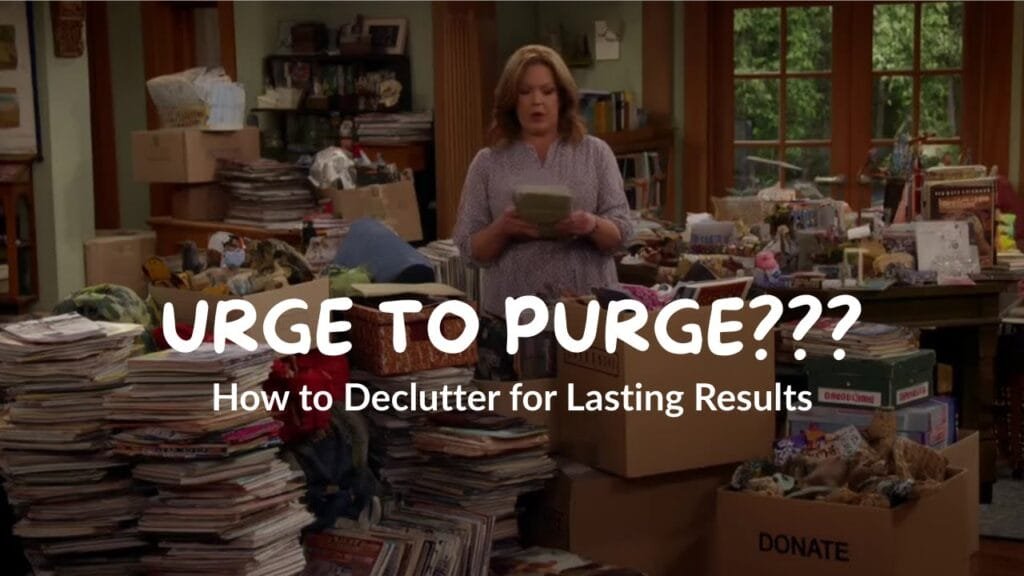

The urge to declutter usually shows up all at once. You look around and think, I cannot stand this room one more day. And then, right behind it: where do I even start? That’s exactly what this guide is for. Mary and I want to help you declutter like a pro, which really just means having a process you can lean on instead of an overwhelming pile and a lot of feelings.
This phase isn’t about making things pretty yet. No labels, no matching baskets, no buying containers. It’s about clearing enough space to breathe so the organizing can come later and actually work. If you want something to work from, we have a free organizing quick-start guide that pairs nicely with this.
The short answer
Work in small areas, leave items where they already are, and make quick decisions in four rounds: trash, easy items, harder items, and cleanup. Start with what’s obvious, don’t pull everything out, and save sentimental things and paperwork for later when you have more focus. Decluttering goes best when you make it easier on your brain, not harder on yourself.
Mindset comes before method
One thing that jump-started my own decluttering was setting a goal to get rid of 1,000 items. That running tally made me question the stuff I’d always skated past. Did I really need that many spatulas? An extra pair of shoelaces? Was I keeping things “just in case” when replacing them later would be cheap and easy?
Mary’s early breakthrough came from zoning. If you naturally pay bills at the kitchen table, make that easier instead of forcing yourself to a desk in another room because it seems more proper. Your house should work for you. Not for an imaginary version of you, and not for what someone else says a room is “supposed” to be. That’s the whole shift: stop trying to win at housekeeping and start supporting the life you actually live. You’re not organizing yet. You’re not becoming a minimalist unless you want to. You’re not here to feel guilty about owning things. You’re making room for what you love and use. If your past declutters stalled out, it’s worth starting with your decluttering mindset before you touch a thing.
Set up a decluttering station
Before you start pulling things out, make one spot where outgoing items can land instead of drifting back into the room. It doesn’t have to be fancy: a small table, a corner, the top of a cubby. Your station might hold a container for donations, a bag or box for trash, a bin for sentimental items, and a bin for paperwork.
For donations, Mary and I both like containers you won’t have to repack later, because if you handle everything twice, you’re more likely to second-guess yourself. Sturdy grocery pickup bags, carryable cardboard boxes, or trash bags all work. I like black trash bags because you’re not tempted to keep staring at what’s inside. Mary uses black for trash and white for donations so she can tell them apart at a glance. Either way works. Pick what helps you move faster and think less. One caution: don’t choose a container so big you can’t carry it to the car.
Work with items where they already are
Here’s where this method parts ways with the dump-everything-in-a-pile style you’ve probably seen. Instead of emptying the whole space, work with items where they sit. In the kitchen, do one shelf. At your desk, start with the desktop, then a drawer. In the pantry, one section at a time. The reason is simple and kind: at any point, you should be able to stop and still have the room look better than when you started. If real life interrupts you, you’re not left with a mess spread across the floor and every surface in sight. Want to see it in action? Here’s the same approach applied to a pantry and a bathroom.
Round 1: trash
The first pass is always trash. Even in rooms that don’t seem dirty, there’s usually more of it than you’d guess: extra envelopes, packaging, dried-out pens, broken bits, expired products, old inserts, random odds and ends that serve no purpose. Treat it like a game. Look for 20 things. Or 30. That small shift changes how your brain sees the room, from “there’s no trash in here” to actively scanning for what can go. It also warms you up, because tossing obvious trash builds momentum and makes the later calls easier.
Round 2: the easy decisions
With the trash out, move to the calls that don’t need deep thought:
- Broken things and expired products
- Duplicates and triplicates
- Accessories you no longer use
- Bonus items that came with something else
- Marketing materials and promo clutter
- Things you’ve already been thinking about getting rid of
- Items you just don’t love
If you get stuck on something, skip it and keep moving. Quick wins build the confidence that carries you through the harder stuff.
What clutter actually is
Here’s a point that changes everything: the clutter you notice first usually isn’t the real problem. The stuff out on the counter (your purse, chargers, keys, checkbook, coffee mug) is often what you’re actively using. It’s visible because the places it should go are too crowded to use. The real clutter is hiding behind the visible clutter. If the mug cabinet is stuffed, mugs land on the counter. If the hooks are overloaded, bags get dropped on a chair. If the drawer is jammed with old supplies, the current ones stay out. So this work focuses on shelves, drawers, cupboards, and stored inventory. That’s where the decisions actually live.
One of my favorite tricks: use your eyes before your hands. The moment you pick something up, you feel more connected to it, especially if it’s already yours and tied to a memory. So look first. Scan the shelf, notice what jumps out as unnecessary, let your eyes make the first cut, then reach for the obvious discards and donations.
Forget the universal rules, ask better questions
People always want one clean rule. If I haven’t used it in six months, does it go? If I haven’t worn it in a year, do I keep it? Rules can help if they motivate you, but no single one fits every room, every season, and every stage of life. A decorative piece you love might not get “used” in six months and still belong in your home. Sentimental things don’t run on a timeline at all.
Instead of rigid rules, ask a few honest questions: Would you rebuy it if it disappeared today? If it were ruined, would you bother cleaning or replacing it? If it vanished, would you feel relieved or upset? Those tell you a lot. Sometimes you realize you wouldn’t spend a dime replacing that one-use gadget. Sometimes you realize the thing matters more than you thought. Either way, you’ve got your answer. And here’s a strong one if your house feels overfull: if you had to move, would this make the trip? For some things the answer is an instant no. For others it depends, and that’s fine. There may be things you wouldn’t haul across the country but are glad to keep while you have the room. Mary still tells the story of boxes lost in a move years ago, and she never did figure out exactly what was in them. Sometimes the absence of a thing tells you more than its presence ever did.
Decluttering is a rhythm, not a one-time event
Let’s say this plainly: decluttering is never one and done. Things come into the house every single day. Mail, groceries, purchases, gifts, packages, replacements, project supplies. The goal isn’t to “finish forever.” It’s to make decluttering a normal rhythm, so things leave regularly and don’t pile up so dramatically. The good news is it gets easier with practice.
Round 3: the harder items
After trash and easy wins, you’re left with the harder things, the ones tangled up with guilt, money, identity, memory, fantasy, or a decision you keep postponing. Be gentle with yourself here. These are hard because they’re about more than the object. And you don’t need to settle perfect labels, pretty bins, the final layout, focus-heavy paperwork, or sentimental sorting while you’re tired. Right now the only goal is forward motion.
The “I’ll decide later” trap
Setting aside one or two items when you truly need more time is fine. Turning the whole room into a pile of “later” is not. Mary has a good warning about delayed-decision boxes. The idea sounds appealing: put the uncertain stuff in a box, seal it, and donate it in six months if you didn’t reach for anything. But for most people that just means handling the same items twice, storing them in between, and reopening the box later to make every decision over again. That’s not decluttering, that’s churning. If something’s genuinely for a future project, give it a clear purpose, a label, and a realistic timeline. Otherwise, it’s usually better to decide now.
Gift guilt
Gift guilt is one of the most common snags. Here’s the heart of it: once a gift is given, it belongs to you. The giving was the gift. The object isn’t a lifelong obligation. If it’s not your style, doesn’t fit your home, or makes you sigh every time you see it, you’re allowed to pass it to someone who’ll actually enjoy it. That’s not rude, it’s realistic, and most thoughtful givers would hate for their gift to become a burden.
Mean, nasty items
Some belongings just carry bad energy. I call them mean, nasty items. They’re the objects that trigger resentment, embarrassment, pressure, or grief: something from an ex, an old job, a tense relationship, or a season you don’t want replaying every time you open a drawer. The object may be harmless, but if what you really see is a painful memory, that’s your sign. Same goes for clothes or shoes that make you feel bad about your body, your age, or who you used to be. Your home doesn’t need a supporting cast of things that criticize you.
The money you already spent
This one catches almost everyone. It was expensive. It’s worth something. I paid good money for it. All true, and none of it comes back by keeping the item. That cost is already spent and gone. If something really does have resale value, try to sell it. But plenty of things we assume are valuable are just old, out of demand, or worth far less than we think, and they take up more space than the market says they’re worth. Watch for holding onto something for years because you don’t like the original purchase decision. Keeping it doesn’t fix the regret.
A note for crafters and DIYers
Crafters and DIY-minded people see potential everywhere. A jar could be reused. A broken appliance could be taken apart. A scrap could join a project. Sometimes that creativity is wonderful, but it still needs boundaries. My husband needed one bin for things to disassemble and another for extra parts, because without limits, “useful someday” multiplies fast. Mary points out something encouraging: donated craft supplies can be a real gift. Schools, daycares, senior groups, and charity fundraisers can often use them right away. So if you have more than you’ll realistically use, curate instead of keeping all of it. Keep the craft you actually do now and the materials you love using, and donate the rest while it can still help someone.
Identity clutter and fantasy clutter
Identity clutter is the stuff tied to who you used to be, or who other people still think you are. Maybe you collected something once. Maybe you were the one known for loving purses, office supplies, or a particular animal, and even after your tastes changed, the items kept arriving. A funny but true warning: be careful telling people you like cows, chickens, owls, or frogs, because families can turn one passing preference into a gift category for the next decade. You’re allowed to evolve. Adults outgrow things too.
Fantasy clutter is about the life you imagine instead of the one you’re living. Board games you hope everyone will play someday. Hobby supplies for the version of you with free weekends. Gear for a project that belongs to a future season. This one gets emotional, because the item stands for hope and a version of yourself you still care about. But if it’s making you feel guilty, crowded, or sad, it isn’t helping. And letting it go now doesn’t mean forever. Seasons change, and secondhand shops, yard sales, and community resources all exist. You don’t have to store every possible future in your current home.
Round 4: cleanup
The last step is cleanup: take out the trash, move the recycling, get donations to your staging area or car, and return anything from your “belongs elsewhere” basket to the right rooms. A large laundry basket or bag is your friend here, because it keeps you in the space you’re working on instead of wandering off and getting distracted halfway down the hall. If you run out of steam before cleanup, that’s okay. Do the demanding part while you have the energy and finish cleanup later.
Why it’s worth it
Because decluttering is what makes organizing possible. You can cram a lot into a disorganized space, but once you organize properly, the space has to function. You need room to see what you own, reach what you use, and keep the system going without a daily fight. Decluttering also pays off fast. Fifteen minutes can change how a room feels. You lose less time hunting for things, you stop dusting stuff you don’t even want, and the room gets calmer. Best of all, the space starts serving you instead of nagging you.
Quick-start checklist
- Pick one small area, not a whole room
- Set up a donation spot and a trash bag
- Add one bin for sentimental items and one for paperwork
- Bring a laundry basket for things that belong elsewhere
- Start with trash
- Move to the easy decisions
- Skip whatever truly stalls you and keep going
- Do a short cleanup when you finish
- Take donations out of the house regularly
- Don’t buy containers yet
FAQ
What’s the best first step when decluttering?
Start with trash. It’s the easiest category, it builds momentum, and it helps you see the space more clearly.
Should I pull everything out before I declutter?
No. Work with items where they already are, one small area at a time, so the room is better, not worse, if you have to stop.
What should I do with sentimental items and paperwork?
Set them aside in separate bins for later. They usually need more focus than a general decluttering session allows.
Is the six-month rule a good one?
It can help sometimes, but it’s not universal. Use guidelines that fit the room, the item, and your current season of life.
How do I handle gifts I don’t want to keep?
Remember that the gift was the act of giving. If the item doesn’t serve you, it’s okay to donate it so someone else can enjoy it.
Are delayed-decision boxes a good idea?
Usually not. For a lot of people they just delay the same decisions and create more shuffling. It’s often better to decide now or leave the item in place until the next pass.
What is fantasy clutter?
Stuff tied to the life you hope to live someday rather than the one you’re living now. If it’s taking up needed space and causing stress, it may be time to let it go.
One last thing
To declutter like a pro doesn’t mean doing it perfectly. It means having a process you can come back to, trusting yourself to make decisions, and clearing space for a home that works better for this season of life. Start small. Stay in one area. Look for trash first. Let the easy things go. Leave the pretty bins for later.
If you’d like more support from us, come join the monthly live sessions for extra help and encouragement. The biggest takeaway is a comforting one: you don’t need to overhaul your whole house in a weekend. You just need a clear next step and a little room to breathe. Keep going, friend.