
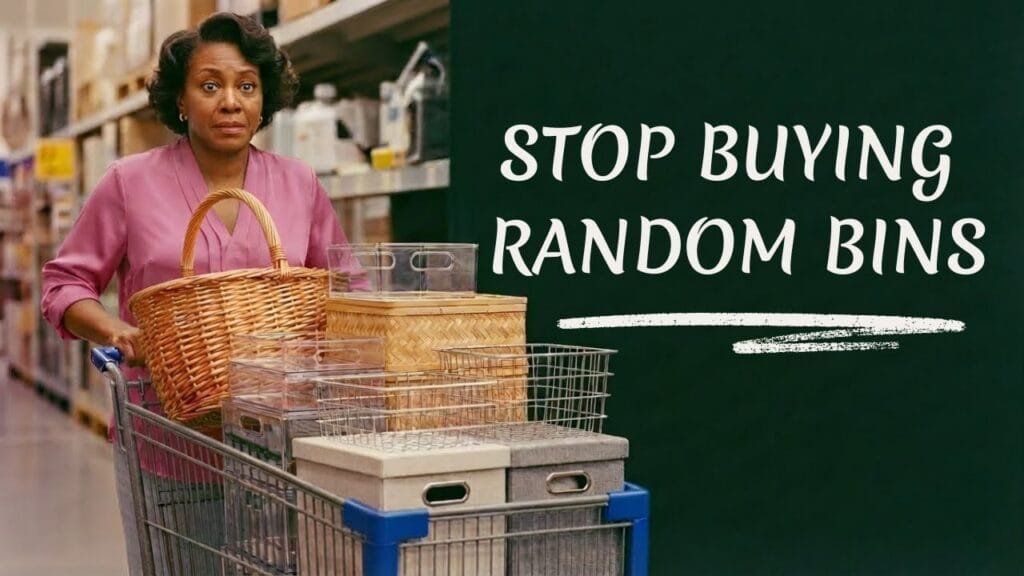

It’s easy to believe the fix for clutter is one more bin. Or a prettier basket. Or that drawer organizer you saw online. Most of us have tried it at least once. You buy the container, bring it home, and somehow the space still doesn’t work.
Here’s why. Organizing bins and containers are tools, not magic. They can genuinely make life easier, but only after you’ve sorted your categories and thought through how you actually live in your home. Mary and I come at this in a pretty practical way: don’t organize for your fantasy self, and don’t shop for a magazine spread. Organize for the season of life you’re in right now, your real habits, and the messy days too.
The short answer
The best organizing bins and containers are the ones that support categories you already sorted, fit your space correctly, and are easy enough to use that things actually get put back. Clear bins tend to help if you need to see your stuff; opaque bins can help if visual clutter overwhelms you. The right pick depends less on what looks good online and more on what holds up in your everyday life.
A bin organizes a category, not clutter
This is the heart of the whole thing: a bin doesn’t organize clutter. It organizes a category. That distinction saves you money, frustration, and that deflating feeling of “I bought all the right stuff and nothing changed.” If a category hasn’t been sorted first, the container just becomes a prettier version of the same mess. New to this? Start by organizing after decluttering so your categories are set.
Mary and I use “containers” as a big umbrella word. Bins, baskets, trays, drawer inserts, shoe organizers, over-the-door racks, pegboards, all of it counts. The product name doesn’t matter. What matters is whether it keeps items together in a way that suits how you actually live.
And that “real habits” piece matters more than most people give it credit for. The goal isn’t a system that looks lovely for one afternoon. It’s something that still works when you’re tired, busy, distracted, or in the middle of one of those very normal weeks when life is coming at you from six directions.
Practical organizing vs. hobby organizing
There’s a useful line between practical organizing and what I call hobby organizing. Practical organizing is what helps your home run. Hobby organizing is the above-and-beyond layer: alphabetized spices, matching floral boxes, color-coded craft supplies, tiny holders for tiny tools.
Nothing wrong with hobby organizing. It’s fun, satisfying, and often beautiful. But it helps to call it what it is, because once you do, you can decide more carefully where to spend your time. A good question to ask: how often do you touch the items in that space?
- Low-touch areas can usually handle more detailed systems, because they stay neat on their own.
- High-touch areas need simpler systems, because they’re used constantly.
Zoning books by topic can work beautifully, because you might only handle them once in a while. Try that same level of precision on your coffee bar and it’s a different story. A heavily used space can look full feral-raccoon by the end of the day if the system is too fussy. So if you love the prettier, more detailed side of organizing, save that energy for places where it can actually hold up. That way it stays fun instead of turning into one more chore.
What containers are really for
It sounds obvious, but say it plainly: we buy containers to contain things. They also do a lot more than that. A good container can:
- Keep a category together
- Stop items from tipping over
- Wrangle awkward shapes
- Create boundaries inside shelves and drawers
- Make a project easy to pick up and move
- Protect things from spills or damage
- Quiet the visual noise
- Sometimes just make a space prettier
Even minimalists tend to love a good tray for this reason. Instead of moving ten separate things, you lift one tray. Containers make cleaning easier too. Dusting one bin beats dusting fifteen little objects. And at a makeup station, a desk, or a bathroom counter, the right organizer makes access so much easier. Brushes stand up. Lotions stay together. The stuff you reach for daily stops hiding.
There’s a decorative side, too. I keep pretty floral boxes in a glass-front bookcase near our entry. There, the containers are part of the decor. They make the space feel welcoming even though they aren’t the most functional storage in the world. Which is a good reminder: containers do different jobs in different places. Some need to be workhorses. Some just need to be lovely.
Uses that actually make sense
- Locking-lid bins for paper projects, Lego, knitting, and temporary project supplies
- Stacking photo boxes to use vertical height instead of spreading out
- Hard-sided storage for fragile collections or seasonal decor
- Mesh zip bags to shrink the bulky footprint of board game boxes
- Decanting things like detergent pods when the original packaging is oversized or awkward
Mistakes worth skipping
- Buying containers before sorting categories
- Picking something because it’s pretty even though it’s a pain to use
- Ignoring how often you handle the items
- Assuming one type of container works everywhere
- Forgetting that organized storage often takes more room than stuffed, disorganized storage
Measure twice, buy once
If there’s one habit that saves both money and aggravation, it’s this: measure first. Not just the shelf. Not just the drawer. Not just the number on the package. Measure the actual space and the actual container.
Mary and I check for:
- Width, depth, and height
- Shelf clearance
- Lips or ridges that mess with the fit
- Door hinges and how far they swing
- Whether the container narrows or tapers
This matters more than people expect. Two bins can carry the same volume on the label and still have different outside dimensions. That’s especially true with the common totes at big-box and home improvement stores. And no, there’s rarely a magical bin that fits your drawer perfectly. That unicorn almost never shows up. But measuring gets you a lot closer to a setup that makes sense. Leave a little breathing room, too. Empty space isn’t failure. Sometimes it’s flexibility: room to grow, easier access, less cramming.
Quick measuring checklist
- Measure the full inside space
- Measure the opening, not just the interior
- Check whether doors, hinges, or shelf lips get in the way
- Read the product dimensions carefully before buying
- Don’t assume bins from different stores are identical
Clear bins or opaque bins?
This is where your organizing style comes in. Mary put it perfectly: if she can’t see it, it doesn’t exist. So clear bins work best for her. Seeing her stuff helps her remember what she has and where it goes.
But clear isn’t automatically right for everyone. Some people feel overstimulated when every single item is on display. For them, opaque bins or fabric containers calm a space down and make it feel manageable. One handy rule from our conversation: vertical tends to be more visual, horizontal tends to be more hidden. If you need reminders in plain sight, vertical storage like pegboards or open wall systems can help. If you’d rather have less visual input, concealed horizontal storage may feel better.
Whichever way you lean, labeling matters. Labels can be plain, playful, or very specific. The point is to cut friction. If you can read the label across the room, even better. One more trick I love: make a map for deeper storage. If a bookshelf, an office drawer stack, or a garage shelf holds less obvious things, a simple printed list helps everyone remember what’s where without labeling every detail on the outside. If you want to dig into your own style, the Clutterbug quiz is a good place to start. For the deeper version, see our guide to Clutterbug and Four Tendencies.
Look at the whole container: material, shape, and use
It’s easy to fixate on color or size, but the whole container matters. Before buying, think about the material, the shape, how it opens, how easy it is to carry, how easy it is to clean, and how it behaves when it’s full.
A few examples stand out. Locker-style bins that taper toward the bottom waste usable space inside. Wicker baskets are pretty but snag things. Fabric bins stain. Wire baskets with big holes let smaller items fall through and can be awkward to lift. Material matters for long-term storage too. Sentimental papers and photos may need archival-quality storage. Seasonal clothing wants airflow and moisture control, especially over long stretches.
And maybe the most important question of all: is it easy enough to put things back? People will usually make some effort to take things out. Putting them back is another matter. If a bin is heavy, awkward, hard to open, hidden behind a door, or too fussy to reach, its contents will end up migrating somewhere else.
Where you shop matters
Where you buy affects quality, price, return flexibility, and whether you can get matching pieces later. Here’s something professionals do: sometimes it’s worth grabbing an extra container or two, especially to avoid another mid-project store run. It also helps to know the return policy in case a plan flops once you get it home. That’s not a license to overbuy. It’s just being strategic and realistic.
Traditional containers: my hits and misses
Some containers earn their keep. Others are cute and frustrating.
The ones that frustrate me
- Flimsy cloth cubes that collapse or stain
- Locker bins that taper inward
- Wicker baskets for anything delicate or snag-prone
- Wire baskets with big openings that let contents fall through
- Plastic drawer units that warp, shift, and are hard to clean
Flimsy containers often need “fixing” with inserts, which can cost as much as just buying something better. Plastic drawers drag their contents forward and back every time they open, so they’re hard to keep tidy unless they’re holding something soft like clothing. Even cloth cubes are a mixed bag. The better ones work well as decor-friendly hidden storage. But if a cube gets used a lot, pay attention to the handle: a built-in hand opening tends to hold up better than a decorative pull that stretches out over time.
The ones I reach for
- Clear bins or simple opaque bins that are versatile and easy to repurpose
- Narrow shelf bins that customize awkward spaces
- Freezer-friendly organizing bins
- Stacking storage for photos and long-term categories
- Specialized hard-sided storage for fragile collections
The principle underneath all of it is simple: invest in containers sturdy enough to last and flexible enough to reuse somewhere else later.
Non-traditional organizers worth knowing about
Sometimes the smartest solution isn’t a standard bin at all.
Favorites
- S-hooks for hanging things from wire shelving, rafters, or other structures
- Velcro or wire straps for wrangling bulky items
- Magnetic bars for tools, scissors, knives, and craft supplies
- Strong magnets for any metal surface, including doors and travel setups
- Pegboards for visual vertical storage
- Magnetic paper towel holders to free up counter space
- Peel-and-stick index card pouches for labels you can swap out
Ones I’d skip
- Vacuum-seal bags for long-term clothing or soft-goods storage
- Pre-made drawer boxes for foil and wrap when a regular drawer already holds them
- Pre-made cord labels when a bit of washi tape does the same job
There’s a thread running through all of these. If a non-traditional organizer solves a real problem, use it. If it’s mostly adding cost without improving function, skip it.
Where to shop
Mary and I bounce around a lot of stores, and each one has its strengths:
- Dollar Tree for select seasonal or simple pieces (watch the changing sizes and quality)
- The Container Store for specialized pieces, though you’ll pay for them
- IKEA for structural storage, shelving systems, and affordable basics
- Walmart and Target for accessible dupes and general-use bins
- Craft stores for hobby storage, decorative boxes, and archival supplies
- TJ Maxx and HomeGoods for one-off finds and decorative options
- Harbor Freight, Lowe’s, and Home Depot for utility bins, shelving, pegboards, and garage solutions
- Amazon for specialized storage, with careful dimension checking and easy returns
If the garage is on your list, we made a garage organization resource that might help. And here’s what you don’t need to worry about yet: you don’t need the prettiest matching set, you don’t need to buy everything from one store, and you don’t need to solve every drawer and shelf at once. Start with the areas that need the most support. Choose function first, and let beauty come in where it makes sense and won’t make the system harder to keep up.
Quick-start checklist
- Declutter and sort into real categories before you shop
- Think about how often you use the items
- Decide whether you need visibility or less visual stimulation
- Measure the space carefully, clearance included
- Check the bin’s actual dimensions, not just its volume
- Consider material, cleaning, and ease of use
- Label clearly, especially for hidden storage
- Use specialty storage only when it truly solves a problem
- Shop where the price and return policy make sense for you
FAQ
Should I buy organizing bins before I declutter?
No. Containers work best after you’ve sorted and reduced what you’re keeping. Otherwise you’re just boxing up unsorted clutter.
Are clear bins better than opaque bins?
It depends on your organizing style. Clear bins help if you need visibility. Opaque bins help if seeing everything feels overwhelming.
Why do organized spaces sometimes take up more room?
Because things are stored in a way that protects them, keeps categories distinct, and makes them easy to reach. Cramming saves space, but it usually costs you function.
What’s the biggest mistake people make when buying containers?
Buying for the look instead of the function. A close second is skipping measurements and assuming a bin will fit.
Do I need specialty organizers for hobbies?
Sometimes, yes. For detailed hobbies like sewing, woodworking, or knitting, specialized storage can work better than trying to improvise.
Are fabric bins a good choice?
They can be, especially for decor-friendly hidden storage. Just know that lower-quality fabric bins may collapse, stain, or wear out fast.
How do I label storage without labels all over the front?
Use discreet labels, changeable index card pouches, or a simple storage map for shelves, drawers, or deep bins.
One last thing
Choosing organizing bins and containers well is less about finding the prettiest solution and more about picking the one you’ll still use on a hard day. That’s what makes a system last. If a container supports a real category, fits the space, suits your habits, and makes putting things away easier, it’s doing its job. If it only looks good but adds friction, it’s probably the wrong tool for that spot.
If you want a little help getting started, you can download our free organizing quick-start guide. And if you’d like to keep learning with Mary and me, come join the monthly live community for more practical support and upcoming sessions. Sometimes one well-chosen container really does make life easier. Just make sure it’s working for your real life, not your fantasy organizer. Keep going, friend.