

If you’ve been staring at a room thinking “I know this needs help, but I don’t know where to start,” you’re not alone, and deciding to hire a professional organizer might be the most practical next step you take. A lot of us can juggle plenty in life, but when the house feels behind, the paper piles grow, or a space just stops working, it gets mentally exhausting fast.
Mary and I are both professional organizers, and here’s something we want you to know going in: organizing isn’t just about making a room pretty. It’s about building systems that fit your actual life, your routines, your family, your energy, your limitations, and yes, your feelings about your stuff. If you’re wondering whether professional organizing is worth it, what happens in a session, or how to find someone who’s a good fit, let’s walk through it.
The short answer
Hiring a professional organizer helps you make faster, clearer progress when you feel overwhelmed, stuck, or short on time. The right one helps you declutter, make decisions, build systems you can actually keep, and get through the emotional and practical parts of the work. The trick is finding the right kind of organizer, asking good questions up front, and remembering that the best system is the one you’ll maintain.
Two kinds of organizers (and why it matters)
Not all professional organizers work the same way, and the difference matters more than most people realize. There are, broadly, aesthetic organizers and functional organizers.
Aesthetic organizers are known for beautiful, polished spaces: matching bins, coordinated labels, color-coded systems, the kind of pantry that photographs beautifully. There’s absolutely a place for that. If your goal is a magazine-worthy closet, this may be exactly what you want. Just know it tends to cost more, because the pretty storage and styling add to the budget.
Functional organizers start with how a space works. The goal is a system you can live with day after day, not one that looks impressive for an afternoon. That usually means decluttering first, using bins you already own, shopping your own home for temporary fixes, building around your routines and limitations, and recommending products only after the space is edited. In most homes, that practical foundation is the part that matters most.
Sometimes the smartest path is both: start with a functional organizer to do the decluttering and system-building, then bring in an aesthetic organizer later to refine and beautify once the space already works. And many organizers specialize. I lean toward paperwork, small business systems, and entrepreneurs getting organized; Mary focuses on home organizing and transitional downsizing. Others focus on families, seniors, neurodivergent households, or virtual organizing. That’s exactly why fit matters so much.
Why people bring in help
Sometimes the real question isn’t “can I do this myself?” It’s “do I want to keep carrying this by myself?” People reach out when they feel overwhelmed by a space or a season of life, when they want results faster than they’re getting solo, when they need help making decisions, or when they want a neutral, experienced person beside them. It also helps if you have limited energy or mobility, if you’re in a transition or downsizing, if there’s ADHD or another neurodivergence in the family, or if you’re emotionally stuck on sentimental things.
One of the biggest payoffs is momentum. Mary finds that after working with clients in one area, they often go organize another space on their own before she’s even back. Once you’ve felt a system that actually works, confidence builds quickly. There’s also real value in simply not doing it alone, in having someone knowledgeable say, “Yes, this is doable. Let’s start here.” One honest caveat: professional organizers aren’t therapists. If a situation involves hoarding or deep grief clutter, you may need someone with additional mental health training, or a team approach that includes a therapist or care provider.
Questions to ask before you book
Before you hire anyone, ask clear, practical questions:
- Are you insured?
- How do you charge: hourly, by package, or by space?
- What’s included in your rate?
- Do you charge for travel, prep, shopping, or donation drop-offs?
- How long is a typical session?
- Do you offer in-home, virtual, or both?
- What projects do you specialize in?
- Do you work with other organizers or contractors on bigger jobs?
- Do you offer maintenance sessions?
Many organizers prefer sessions of about three to four hours. That’s usually long enough to make real progress but not so long that decision fatigue takes over. As a general range, expect roughly $55 to $150 an hour depending on your region, the organizer’s experience, and demand. If someone’s well below or above that in your area, it’s fair to ask why.
On training: there’s no single certification that automatically makes someone the best organizer for you. Some train through organizations like NAPO or ICD, others take specialty courses, learn through mentorship, or keep educating themselves less formally. Ask how they learned organizing professionally and how they stay current. Look for someone who can talk clearly about their process and is honest about what they do well and what they don’t.
Privacy is worth raising directly, too. You may want proof someone does good work without your private spaces ending up photographed or posted online. Ask whether they take before-and-after photos, whether anything is shared publicly, and whether you can decline photography completely. Many organizers now limit photo sharing so clients feel comfortable, and a smaller public portfolio doesn’t mean less experience. Often it just means they guard their clients’ privacy carefully.
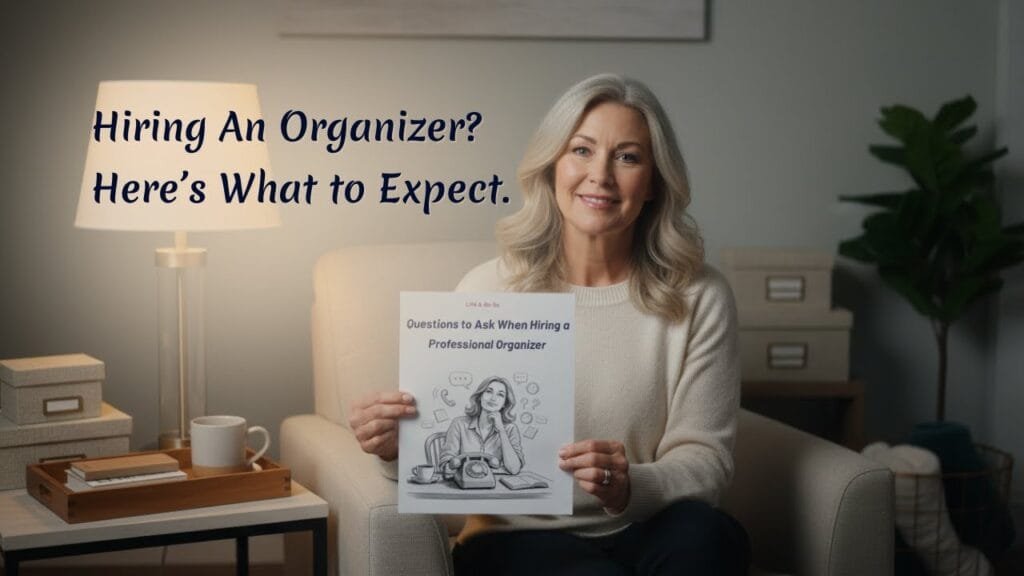
Get the free hiring checklist
We put together a free printable with all the questions to ask before hiring a professional organizer, so you can compare a few options and walk into calls feeling prepared.
The consultation, and one red flag
The consultation is where both sides decide whether the partnership makes sense. It might happen by phone, video, or in person, and a good organizer should ask about your lifestyle, your current challenges, your goals for the space, what success would look like to you, how involved you want to be, and any special concerns or family dynamics. Here’s a practical red flag: if someone gives you a flat project price without seeing the space or learning much about your situation, be cautious. Projects vary a lot based on the size of the space, the volume of belongings, and how much decision-making support you need. This is also the moment to ask about supplies, shopping, mileage, and whether they have a network of other pros if your project needs backup.
What you’re actually paying for
It’s easy to look at an hourly rate and think that seems like a lot. But you’re not just paying someone to move things around. You’re paying for an experienced eye that spots patterns and problems fast, guidance on what will and won’t work in your home, support with the hard decisions, product and layout recommendations, a real game plan, and focused progress without the usual household distractions. Mary says it well: there’s a lot packed into a few focused hours. Unlike organizing your own home, a pro isn’t stopping to switch the laundry, answer the door, or drift into another project. Their attention stays on the task.
Working together well
If you want your family on board, start with the why. Describe how you want the space to feel and function: calm, easy to maintain, easy to find things in, less frustrating. It helps to set a few ground rules too, like who decides what stays in shared spaces, who has full say over personal spaces, and what the goal for the room is. Sometimes an organizer helps just by being a neutral third party, because family members often hear the same message differently from someone outside the household.
There’s no single right way to participate, either. Some clients want a say in every decision; others explain their preferences, step away, and check in. Both work. If you need to touch every item and talk through each call, that’s fine, it just takes longer. The clearer you are about your priorities, the more effective the session. And one of the most reassuring things Mary tells people: no, you will not be forced to part with your belongings. You stay in control. A good organizer may suggest something’s no longer serving you, or explain how much needs to leave for a space to function, but the final call is yours. If an item’s story matters, say so. What looks like an old sweatshirt to someone else may be comfort, memory, or identity to you, and the more honest you are, the better the support.
Before they arrive
- Don’t tidy up just to make the house look better
- Secure cash, jewelry, and sensitive documents if that gives you peace of mind
- Flag any concerns about papers, private areas, or pets
- Mention firearms, medical supplies, pet waste, pests, or anything hazardous
- Make sure someone you trust knows a service provider is coming
During the session
- Stay engaged, or agree on check-in times
- Speak up if a system feels too complicated
- Be honest if you’re overwhelmed
- Ask questions so you understand the logic behind the system
The best system isn’t the fanciest one. It’s the one you’ll actually keep using.
If you get emotional, that’s normal
If you cry during an organizing session, that’s not strange, dramatic, or embarrassing. It’s normal. Belongings carry memory, identity, grief, guilt, hope, and history. Sometimes people cry because they’re letting go, sometimes because they finally feel relief, sometimes because they’re exhausted and supported at the same time. A good organizer knows emotions are part of the work. You may need a short break or a little space, and that’s completely okay.
Where to start (yes, one room counts)
You can absolutely hire a professional organizer for a single room, and it’s a very common place to begin. A pantry, closet, entryway, playroom, or home office makes a manageable first project, and once one room works, the next feels easier. Starting small is still starting.
If you genuinely don’t know where to begin, that itself is a good reason to bring in help. I usually start by naming the pain points, talking through organizing style, and picking an area that gives useful progress without being too emotionally loaded. Kitchens and entryways are common starting points, because they shape daily life and usually hold fewer sentimental items than bedrooms or family keepsakes. Organizing can feel a bit like Tetris: one area may need attention first so another can function later, and a pro can help map that out.
And please, don’t clean for them. The current state of a room is useful information. A pile on the counter shows where mail naturally lands. A worn path shows how the household moves. Those patterns are clues. If you feel truly ready to declutter beforehand, that’s fine, just be realistic, because some people gain momentum that way and others stall out before the session even starts. If you want to warm up first, my declutter like a pro guide is a gentle place to begin. And skip the container store for now: you’ll know what storage you actually need after the space is edited, and most homes already have enough usable bins once the excess is gone. When you’re ready to shop, here’s how to choose bins and containers.
After the session
Organizing is rarely one-and-done forever. Sometimes you’ll want a follow-up to tweak a system. Sometimes life changes the needs: kids grow, parents move in, people move out, paper piles up again, seasons shift. If a system stops working once you’ve lived with it, that doesn’t mean the project failed, it just needs adjusting, and many organizers will answer quick follow-up questions or come back to fine-tune. Plenty offer maintenance sessions, seasonal help, or return visits, everything from putting away holiday decorations to revisiting paperwork on a regular schedule. That can be a very practical option if you want support without trying to keep everything perfect on your own.
Quick-start checklist
- Pick one problem area you want help with
- Think about how you want that space to function
- Write down any special concerns or limitations
- Don’t buy containers yet
- Ask about insurance, pricing, and services
- Discuss privacy and photo preferences up front
- Be honest about emotional or family challenges
- Show the space as it really is
FAQ
How do I know if I need a professional organizer?
If you feel overwhelmed, stuck, short on time, or unsure how to make a space function better, one can help you move forward with a clear plan and hands-on support.
How much does a professional organizer usually cost?
A typical range is about $55 to $150 an hour, depending on location, experience, and what’s included.
Should I clean or tidy before the organizer arrives?
No. It’s more helpful for them to see how the space is really used, so they can design systems around your actual habits.
Do I need to buy bins before hiring someone?
No. Decluttering and organizing come first. After that, you can decide what storage is truly needed.
Can I hire one for just one room?
Yes. Many people start with a single room, like a pantry, closet, entryway, or office, and build from there.
Will an organizer make me get rid of my things?
No. A good organizer may make recommendations, but you stay in control of what you keep and what you let go.
What if I get emotional during the session?
That’s normal. Organizing can bring up memory, grief, relief, and stress. A skilled organizer understands that’s part of the process.
What if the system stops working later?
Systems sometimes need adjusting once you’ve lived with them. Many organizers answer follow-up questions or return for a tweak session.
One last thing
If you’ve been wondering how to hire a professional organizer, hold onto this: a good organizer is a guide, not a boss. You should feel supported, respected, and included. The right person won’t shame your home, force your decisions, or build a system that only works in theory. And if the first one you try isn’t the perfect fit, that doesn’t mean hiring help was a mistake, it just means you’re still learning what kind of support works best for you. Organizing can change how a home feels, not because it becomes perfect, but because it becomes easier to live in.
For more real-life organizing help, browse our organizing playlist, and come join the Life A-Go-Go community for resources and upcoming live sessions. Keep going, friend.