
If you’ve tried to declutter before and ended up tired, frustrated, and surrounded by half-finished piles, you’re not alone, and the fix is probably a decluttering mindset, not more willpower. A lot of us assume the piles mean we lack discipline or just aren’t “organized.” More often the real issue is simpler: the process started with the stuff instead of with your head.
That’s the heart of this first lesson from our series. Instead of starting with bins, labels, or a dramatic pull-everything-out marathon, Mary and I start with the part that usually gets skipped: how you think about the work before you begin. Because decluttering isn’t just sorting objects. It’s making decisions, managing feelings, working within your energy, handling family life, and letting your home reflect who you are now, not who you used to be and not who you think you should be.
The short answer
A good decluttering mindset starts with clarity, not criticism. Before you begin, know why you want to declutter, what you want the space to do for you, what no longer fits your life, and where the outgoing items will go. That bit of mental prep turns decluttering from an exhausting slog into something with real momentum.
Quick-start checklist
- Name the one space bugging you most right now
- Write down why you want that space to feel better
- Set a timer for 15 minutes
- Decide in advance where donations, trash, memorabilia, and paperwork will go
- Turn off phone notifications and ask your family not to interrupt
- Start with an easy, winnable area if you need a confidence boost
The five phases, and why mindset is first
Mary and I teach organizing in five phases: mindset, declutter, organize, optimize, and maintain. At first glance that sounds like more work than the usual “pull it all out and put it back nicely.” But a simple-looking process isn’t always an easy or sustainable one. A lot of organizing videos make decluttering look fast because they skip the mental labor. They don’t talk about decision fatigue, emotional attachments, energy limits, or what happens when life changes and your old systems stop fitting.
This framework slows the beginning down just enough that the rest gets easier. Not perfect. Just easier, and a lot more realistic for a busy home. That matters because organizing isn’t a one-time event. Like laundry, it’s ongoing. Stuff keeps coming in, needs change, schedules change, seasons of life change, and a good system has to make room for all of that.
Start with your brain, not your closet
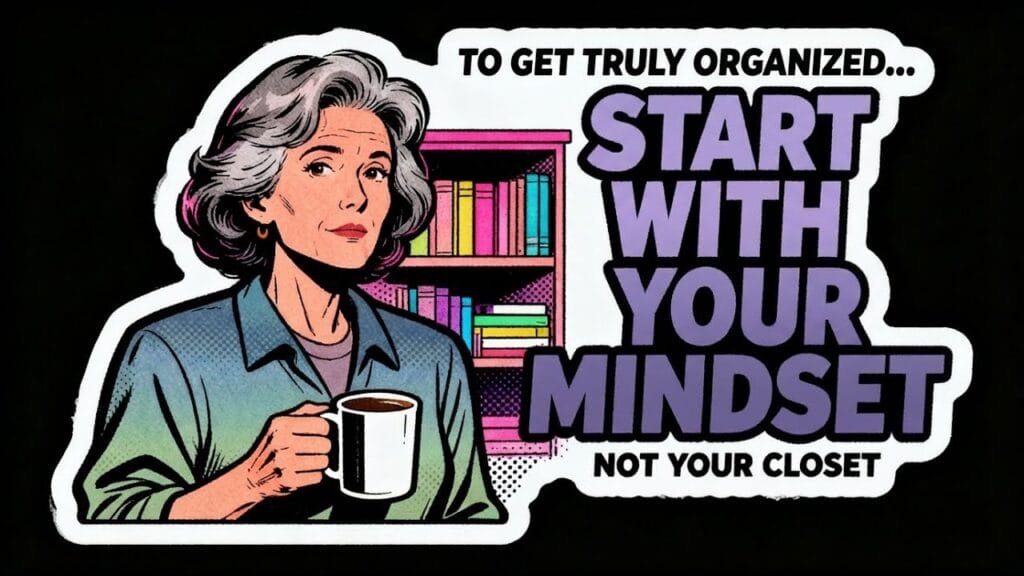
The biggest shift is moving from judgment and overwhelm to optimism and momentum. That sounds nice, but it’s also practical. If you walk into a room already feeling defeated, your brain is braced for stress, every decision feels heavier, and every object seems loaded with history, guilt, or doubt. That’s one reason past attempts fail even when you genuinely wanted to make progress. Mary puts it simply: start with your brain, not your closet.
A good decluttering mindset begins with your why, and it doesn’t have to be deep or dramatic. Maybe you want easier mornings, a cozy place to sit and read, a clear kitchen counter, or room to craft without moving three piles first. Maybe you’re just tired of a room working like a storage unit instead of a living space. Once you know your why, you have something steady to come back to when the work gets tiring. Instead of “why am I even doing this,” you can tell yourself, “I’m doing this because I want my home to support me better.” One more practical nudge: take before-and-after photos, even when the change feels tiny. A 15-minute session can feel like nothing in the moment, but the photo often tells a different, more encouraging story.
Ask what still serves you now
One of the most useful questions in all of this: what is still serving you now? It shifts decluttering away from guilt and toward usefulness. Maybe you used to quilt and don’t anymore. Maybe you used to tent camp and would now much rather have a cabin or a hotel. Maybe you kept nonfiction books because they were excellent, then realized you never reread them. Maybe you’re holding supplies for a version of yourself that doesn’t feel current.
This is where so many of us get stuck. We expect ourselves to keep liking the same things forever. Here’s a comparison I love: we’d never expect a child to adore the exact same toy year after year just because they once did, yet adults hold themselves to that standard, and that mindset quietly fills a house with old identities. Decluttering works better when your home reflects your present self, not your past self and not your fantasy self. If your interests, routines, body, family responsibilities, or priorities have changed, your space is allowed to change too. That can even mean upgrading. Don’t rush out and buy organizing products before you declutter, but that’s different from thoughtfully choosing better-quality things that fit your life now. Maybe you no longer want 47 mismatched plastic containers and would rather own a few nicer glass ones. That’s not failure. That’s clarity.
When you know too much
Sometimes the problem isn’t that you know too little. It’s that you know too much. I see this all the time with clients who’ve read all the books, watched all the videos, bought the products, and still haven’t made progress. Too much information creates pressure to do it the “right” way, but there isn’t one right way. A method that works beautifully for a professional organizer may not fit your home, your energy, or your schedule. Gathering every item of one category from all over the house can help in theory, and it can also be exhausting. If piling every shoe you own into one heap means you run out of steam before deciding anything, that method isn’t the one for you. A few traps to skip:
- Believing there’s one perfect organizing system
- Buying products before you know what needs organizing
- Copying someone else’s method without adjusting it to your life
- Creating a bigger mess in the name of progress
- Waiting until you feel completely certain about every decision
The goal isn’t to impress an organizing expert. It’s to build a home that functions for you. If you’re not sure which methods actually fit your brain, your Clutterbug and Four Tendencies type can point the way.
Let your home match your current season
This part matters a lot in midlife and beyond, because life doesn’t hold still. Mary talks about how what made sense in one decade may not in another. The hobbies, volunteer work, work materials, and entertaining supplies that once fit your life may not be relevant now, and letting them go makes room for who you are today. Sometimes the change is big: if you no longer host formal dinners, the dining room might serve you better as a library, office, or sewing room. That’s allowed. No panel from a decorating magazine is going to show up and tell you you’re using your home wrong.
Sometimes the change is subtle. A lot of us stopped wearing certain clothes or shoes years ago and never went back, yet the closet still honors an old routine. And there are practical shifts that reshape what you need at home: caring for aging parents, making space for extended family visits, managing chronic illness or reduced energy, an empty nest, or simply trying to save time in a fuller schedule. Look at your home through the lens of your current season and the decisions often get clearer.
Have a plan for where things go
Knowing what to remove is only half of it. You also need a plan for where those items land, or decluttered stuff just becomes new piles. Decide that in advance. If you’re not already someone who carefully recycles every category, a big decluttering session isn’t the moment to launch an idealized recycling system. The first job is to get the item out. That sounds blunt, but it heads off a very common stall: building a complicated “responsible” exit plan for every object and then keeping all of it for six more months.
Be realistic about reselling, too. For most ordinary household items, selling takes more time, photos, messages, and mental energy than it’s worth. If something is genuinely valuable, a consignment shop, auction service, or specialist may make sense, but for everyday clutter, donation is usually the better path. Mary is clear-eyed about older collections: sentimental value and market value aren’t the same. Many once-popular collections just don’t sell well now, and hunting for the perfect buyer can become a long-term excuse to keep storing them. That doesn’t mean your memories weren’t real. It just means the object may not need to stay in your house forever. If giving things to specific people matters to you, set a deadline: offer the item, give a clear response window, and move on if the answer is no or there’s no answer at all. As I like to say, your item is not a cat. You don’t have to find it the perfect home. If donating in a values-aligned way helps you let go, do it, sending art supplies to a senior community or a kids’ program, say, just don’t let “it has to go somewhere perfect” become one more reason it never leaves.
Set up a decluttering station
One of the most useful practical moves is a decluttering station. It doesn’t have to be fancy, just a table, a shelf, a hallway bookcase, or a corner that gives outgoing items a temporary home so they don’t creep back into the space you’re clearing. Yours might include a donation bin, extra trash bags, a spot for things headed to another room, a container for memorabilia, and a container for paperwork.
Those last two matter because memorabilia and paperwork can halt progress fast. If you turn up grandpa’s watch, old school papers, or an official-looking document, you don’t have to solve it on the spot. Drop it in the right bin and keep moving. That’s also why we suggest not starting with memorabilia, collections, or paperwork, they’re emotionally heavy, logistically messy, or both. Begin with easier wins instead: bathrooms, entryways, small drawers, or visible areas that give you a quick boost. And don’t worry yet about perfect containers, deep sentimental sorting, whether every donation goes to the ideal person, or making the whole house consistent all at once.
Get your family on your side
Decluttering goes better when the people around you understand what you’re doing and what you need. For Mary, family support starts with protecting your time and attention. If you’ve set aside 15 minutes, an hour, or two, ask not to be interrupted unless it truly matters, because once that flow breaks, it’s hard to get back. Same goes for your phone. Turn off notifications, or put it in another room. That little ding pulls your brain right out of the task.
Here’s another one a lot of us know well: interrupting yourself. Suddenly the mail needs checking, the laundry needs flipping, dinner needs planning. The brain gets very creative when it wants to dodge a hard decision, so part of family support is really self-support, staying with the space you chose until your session is done. As for other people’s things, Mary and I do it a little differently. She prefers that each person handle their own stuff. I’ll sometimes set items I suspect are unwanted into a donation bin while making it clear my husband can pull back anything he wants to keep. The bigger lesson: talk about expectations ahead of time. It all goes smoother when it doesn’t feel secretive or accusatory.
Fifteen minutes really counts
This might be the most encouraging part. Fifteen minutes counts. A lot of us dismiss short sessions because they don’t seem like enough, but you can clear a drawer, pull the trash, sort duplicates, or make a real dent in a small area in that time. And if 15 minutes is what your life or energy allows right now, that’s still genuine progress. Here’s the math: 15 minutes a day adds up to more than 11 working days over a year. That’s not trivial. That’s a serious investment in your home.
There’s a mental upside to the short window too. You can check in and notice what’s happening. Are you making decisions, or drifting? Getting lost in memories? Reading every book cover instead of clearing the shelf? That awareness helps you pick better spaces and strategies next time. For anyone with chronic illness, fatigue, or variable energy, this planning is even more useful. I like to map tasks to energy: on a low day, sort one drawer while seated; on a moderate day, have someone bring a bin down for you to review; on a high day, take on a bigger zone. It honors reality instead of fighting it.
The takeaways
If decluttering has felt hard, that doesn’t mean you failed. It may just mean you started without the mental prep that makes it manageable. The core of it:
- Start with your why, not with shame
- Let your home reflect your present life, not outdated versions of yourself
- Don’t overcomplicate it chasing the perfect method
- Decide in advance where outgoing items go
- Use a decluttering station to contain the messy middle
- Don’t begin with paperwork, memorabilia, or collections
- Ask for family support and cut the interruptions
- Trust that 15 minutes is enough to matter
What’s next
This mindset piece is the foundation, but it’s only the start. Next comes the decluttering itself: how to actually move through a space, what to pull first, and how to keep from getting bogged down by the emotional stuff. My declutter like a pro guide walks through exactly that, so it’s a good place to head once you’re ready. And once the decluttering’s done, organizing after decluttering is the natural next step. Before then, set up your decluttering station now: gather a few bags or bins, make a spot for donations and trash, and decide where paperwork and memorabilia will wait. That way you’re not starting from scratch when you begin.
One last thing
A good decluttering mindset isn’t about becoming a different person. It’s about making thoughtful decisions that support the life you’re living now. You don’t need to do the whole house in a weekend. You don’t need the perfect system. And you don’t need to prove anything by making this harder than it has to be. Start with one space, one reason, one 15-minute block. Let that be enough for today.
If you’d like to keep learning with Mary and me, come join the Life A-Go-Go community for the rest of the series and more real-home, real-life help. Keep going, friend.